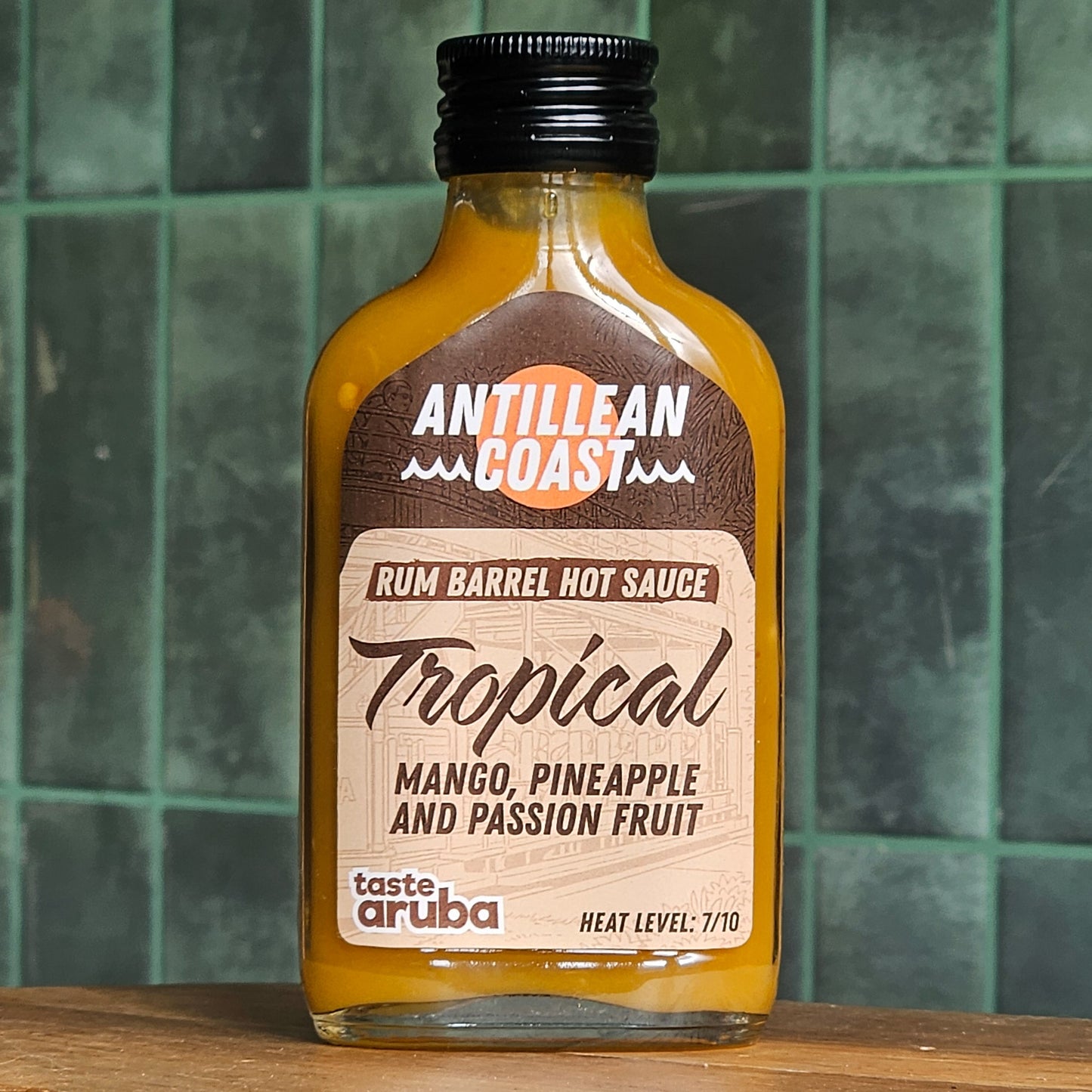
Rum Barrel Tropical Hot Sauce
The first barrel we ever filled with hot sauce is an oak barrel that aged Dominica rum for 15 years. The sauce we filled it with has the same recipe as the Tropical Tres hot sauce. This sauce was selected because of its naturally high content of vitamin C, an important antioxidant that helps preserve freshness in a hot sauce that is more than 70% tropical fruits. While this sauce underwent more of a cask finish than a proper "age," we couldn't have left it longer because tropical fruits simply don't age well. Six weeks in the barrel was more than enough to extract the residual aromas and notes from an oak barrel that had aged rum for over 15 years.
Getting Started
As with everything you do for the first time, there was a learning curve. Not only in technique but also in research. When bottling directly from a kettle there is very little to worry about if your pH levels, salt and sugar content, cooking temperature, and times are correct. You just hot-fill your bottles and the temperature itself will take care of disinfecting them.
This was a different story entirely. I was going to let the sauce sit in a wooden barrel for 6 weeks. Oak barrels are not airtight, which means some air and oxygen would inevitably get in. Because of my kettle size, I also had to do 3 production runs and store the sauce in a 200L food-safe plastic barrel. The plastic barrel could not be hot-filled, which meant the sauce had to be cooled down before being transferred. This also meant the fill temperature would not be sufficient to act as a disinfectant.
The Sauce
The Tropical Tres is a classic Aruba-style hot sauce: very high in tropical fruit content, with a relatively high salt content (around 5%), which is obligatory in a sauce with fruit content this high. On top of that, I use Madame Jeanettes for proper tropical flavor and heat. Some mustard and piccalilli also make their way in there, both quite popular ingredients in Caribbean pepper sauces.
The Barrel
By sheer luck, I discovered while doing this project that one of Europe's biggest wholesalers of rum is located literally 100 meters from my kitchen and warehouse. I had no idea this company existed. I only found them by searching online for somewhere in the Netherlands that might have a rum barrel available. A few emails later and I was excited to hear I could come pick one up at E&A Scheer. They even gifted me a bottle of their own house blend. Thank you!
The barrel I received is an American oak barrel that was used exclusively to fill rum on the island of Dominica. It was later exported to the UK, where it sat for 15 years before being sold to E&A Scheer in Amsterdam. After a customer purchased the contents, the barrel stood empty and not much later, it was sitting in my warehouse.
Prepping the Barrel
This was by far the most challenging part of the process. It essentially required three things: swelling the barrel, cleaning the barrel, and disinfecting the barrel.
Swelling the Barrel
I'm fairly certain that trying to swell a barrel in the middle of winter is considerably harder than doing it on a warm summer day. For those unfamiliar: a dry wooden barrel leaks. Only once the wood has absorbed enough water to swell and press tightly against itself does it become leakproof. When everything is frozen and water comes out of the tap at 5 degrees Celsius, swelling takes much longer than most online guides would suggest. The whole process took about a week, a week full of constantly wetting, filling, shaking, and flipping the barrel to ensure it absorbed moisture faster than it lost it. You'd think winter would help keep things wet, but cold wind is dry and draws moisture out quickly. Since the barrel was sitting outside and leaking most of the time, it felt like a full week of non-stop babysitting.
Cleaning the Barrel
The moment a barrel is emptied, it becomes vulnerable. Residual moisture, oxygen, and leftover liquid create the perfect conditions for it to go bad. Cleaning the inside promptly is essential. The challenge is the how, especially when the bunghole is small and you can't reach inside with your hand or arm. Fortunately, others have solved this: sodium percarbonate.
Sodium percarbonate is a dry, granular compound that releases hydrogen peroxide and soda ash when dissolved in water. Poured into the barrel with hot water, it forms an oxygenated cleaning solution that penetrates the wood surface and breaks down organic residue left behind after emptying. The solution fizzes as it works, lifting deposits and neutralizing odors without leaving harmful residues. Once the reaction is complete and the liquid is drained and rinsed out, the barrel is clean and ready for the next step.
Disinfecting the Barrel
After cleaning, the barrel also needs to be disinfected. There are a few ways to go about this. I almost made the mistake of following winemaking videos that show barrels being disinfected with a sulfur stick. I even bought the sulfur and had it delivered before realizing it would completely ruin my hot sauce. The correct method was steam. I bought a small steam machine and blasted steam through the bunghole long enough to ensure no microorganisms could survive.
Filling the Barrel
I'm glad I decided early on not to make the hot sauce on the same day as disinfecting the barrel. I initially thought doing both in one go would save me the trouble of using an intermediate storage tank, but investing in the plastic barrel and running production on completely separate days was absolutely the right call. Getting the barrel ready had taken serious effort, and rushing the fill would have been a mistake.
Filling should happen quickly after disinfecting. In fact, swelling, cleaning, and disinfecting should all follow one another in fairly quick succession, so that each step doesn't undo the previous one.
Once the barrel was disinfected, I transferred the sauce from the plastic barrel into the oak barrel without delay.
Keeping an Eye On It
I knew the sauce would slowly permeate the barrel. I'm still not entirely sure how it works at a microscopic level, but what was clear is that the barrel was losing moisture, even though only a very small amount was ever visible as liquid on the ground. Somehow, moisture was escaping through the wood. At the three-week mark I opened the bunghole and had to pour in an extra 3 to 4 liters that I'd set aside for exactly this reason. Minimizing headspace is important, both to reduce oxygen exposure and to maximize contact with the wood.
At 4.5 weeks I did the same thing again, though this time much less was needed.
At 6 weeks, I transferred the sauce from the barrel back into the plastic barrel.
Evaluation of the Flavor
The sauce is hard to describe. The presence of so much tropical fruit means the most pronounced flavors are, thankfully, still those of aromatic tropical fruits. The subtlety of the introduced aromas was what we were after. I taste quite a lot of toasted coconut, molasses, rum, and vanilla. It really does taste like a cocktail-inspired hot sauce. It's definitely not a cocktail, and I'd hesitate before using it in one (the salt content would fight you), but as a hot sauce it works really well.
Color and Texture
The sauce is noticeably less vibrant in color compared to straight-to-bottle Tropical Tres batches. That was expected, both from some oxidation and from the charred interior of the barrel. Surprisingly, the texture became noticeably smoother than when it went in. There are still plenty of intact mango fibers (notoriously hard to break down without an industrial blender), but the overall mouthfeel is rounder and more refined.
If I had to describe it in one sentence it would be:
A mango, passionfruit, and pineapple hot sauce with notes reminiscent of a rum punch, shaped by a short barrel finish.

Antillean Coast
Rum Barrel Tropical
Share